Signed in as:
filler@godaddy.com
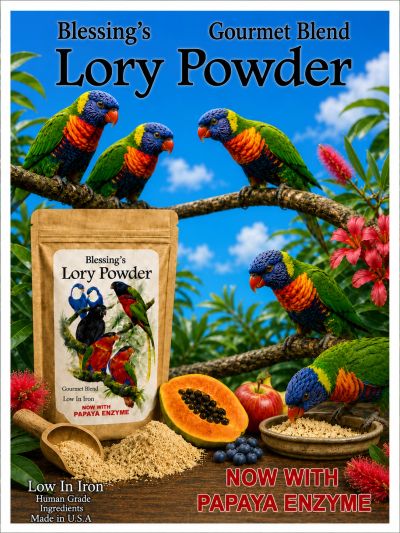
At Lory Food Products we are a green company, powered by 56 solar panels that run our production facility. We use environmentally responsible, human‑grade ingredients in every formula, and we make each batch fresh to order. Our products have a one‑year shelf life at room temperature, and when frozen they maintain their quality for up to two years. We are now set up in South Carolina for convenient shipment pickups.
We believe the type of protein is the single most important ingredient in lory diets. That is why we use only soy protein isolate at 90% purity. It is more expensive, but it is the best source of highly digestible protein for lories and lorikeets based on our experience.
About five years ago, we tested wheat protein isolate at 90% purity. Although it is very digestible for humans, we saw serious problems in breeding lories and found that it was not well digested by them. Three years ago, we tried pea protein, which costs about half as much as soy protein. Lab testing from a Midwestern laboratory showed that pea protein raised iron levels, which can be dangerous for lories and softbills. Those results confirmed our decision to rely on high‑quality soy protein isolate instead.
From 1990 - 2009 I had over 300 parrots that I worked with. Great bills; Eclectus, African greys, Rosies, Lories, Conures, and Parrotlets that I imported in from UK with Eric Yonkers. With the 2009 recession I decided to supply food since bird sales slowed down.
There are many beautiful lories and lorikeets available today, along with a growing number of foods marketed for them. Back in 2009, however, it was difficult to find a consistent supply of quality lory food. That challenge is what motivated me to start Lory Food Products.
I began with Don Wells’ recipe and then spent six months in Australia learning directly from top lory breeders—my family lives there, so I could immerse myself in their methods. Adam Lock served as my mentor and coach. One key principle I learned from Australian breeders is to avoid high‑iron ingredients. Their mixes do not include spirulina or other iron‑rich components, and we follow the same rule in our formulations.
While observing lories and lorikeets in Australia, I saw them feeding on pollen from flowering gum trees, grevilleas, bottlebrush, banksias, camellias, and similar plants. They also frequently visited fruit orchards and agricultural crops, which often led farmers to consider them pests.
In the wild, their primary foods are flower pollen and nectar from blossoms and trees. They will also eat small amounts of seeds, along with grubs and insects. To handle pollen and nectar efficiently, they have a specialized bristle‑tipped tongue that is unique to this group of birds.
Many products marketed for humans include bee pollen, but bee pollen is a different material than flower pollen. It is not a natural dietary item for lories and lorikeets. Bee pollen can range from about 2% to 30% protein, depending on hive health, where it is produced, and how it is processed. Because of this variability and because it is not part of the natural lory diet, we do not include bee pollen in any of our formulations.
Our THRIVE lory food was developed to mimic the natural diet of wild lories and lorikeets as closely as possible. It is being distributed to pet stores and distributors and is intended for everyday use with companion and exhibit birds.
I worked closely with Will Peratino to refine THRIVE and make it the best food we could offer. Will has many years of experience in parrot nutrition and has been employed by major zoos, where his role included traveling to different facilities and correcting their bird diets. Together, we made and adapted the changes needed to align our food with what lories truly require.
We do not believe that testing only the product itself is enough. To understand how a species uses a diet, you must know what is actually digested and what is simply excreted. For that reason, we evaluate lory stool samples to see which components are being absorbed and which are passing through. This helps us fine‑tune our formulas for real‑world digestion, not just lab numbers.
Introducing a new food was not easy. Many people were accustomed to products that resembled blueberry candy. The transition required patience and education. However, once keepers switched to our food, they stayed with it. They consistently reported that their lories were more active, showed better coloration, and produced about 50% more offspring.
We found it necessary to create a second product because breeding lories have higher nutritional demands than pet and exhibit birds. This led to our Lory Breeder Blend.
In this blend, we raised the protein level from 11% to 16% to support breeding birds’ needs. We also formulated it with highly bioavailable calcium, vitamins, and minerals. Will Peratino carefully reviewed each ingredient to optimize the product for breeding lories. For successful reproduction, the key elements are properly digestible protein, a balanced vitamin‑mineral profile, and sufficient calcium for eggs.
Fresh fruits and vegetables remain an essential part of an optimal diet. To support this, we include ground fruits and vegetables in our products, while still encouraging owners to offer fresh produce daily.
All milling is done on site, in a clean environment, which allows us to control quality from start to finish. Because I have bred parrots for more than 20 years, I know that strong production and good health depend on using top‑quality food and being willing to invest in it. Cutting corners on ingredients or processing has always led to failure, so we do not compromise.
Our team is dedicated to keeping your lories healthy. Everything we do—from ingredient selection to solar‑powered production—is designed to support the long‑term health, vitality, and breeding success of these birds.
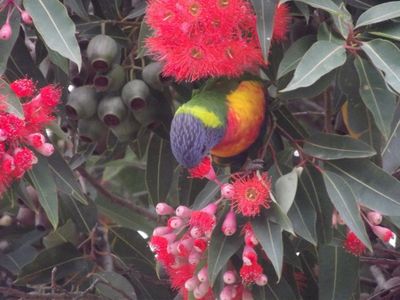
Notice the green spirulina color in the nectar.
Spirulina is generally considered an unsuitable and potentially dangerous additive for lory and lorikeet nectar diets. Your assessment regarding its high iron content and the lack of evolutionary precedent is supported by avian nutritional science.
The Threat of Iron Storage Disease
Lories and lorikeets (along with toucans, mynahs, and birds-of-paradise) evolved on wild diets naturally deficient in iron (primarily nectar, flowers, and soft fruits). Consequently, they lack an effective down-regulation mechanism in the gut to excrete excess dietary iron.When fed iron-rich ingredients, they hyper-absorb the mineral, leading to hemochromatosis (iron storage disease / ISD):
Evolutionary Matrix Showing Spirulina Incompatibility for Lory's and Lorikeets Ecological FactorWild Sources of Foods for Lory'sCommercial SpirulinaHabitat & ForagingCanopy-dwelling arboreal foragers feeding on terrestrial plant blossoms (Eucalyptus, Banksia, Grevillea) .Aquatic, filamentous cyanobacterium that blooms in high-salinity, highly alkaline inland lakes (e.g., Lake Texcoco, Lake Chad) .ExposureZero natural exposure to aquatic blue-green algal biomass in the wild canopy.Novel agricultural feed ingredient cultivated in alkaline open ponds or photobioreactors.Nutrient AdaptationAdapted to process simple sugars, floral lipids, and free plant amino acids .Dense, cell-wall-rich microbial protein suited for omnivores or iron-deficient animals, not iron-sensitive frugivores/nectarivores pmc.ncbi.nlm.nih+1.
Summary for FormulatorsWhile spirulina is often marketed as a "superfood" for granivorous companion birds or poultry (which have higher iron tolerances and benefit from its carotenoids for feather pigmentation), its high mineral density presents significant risks in nectar formulations.Safe pigmentation and protein for lories are achieved using low-iron botanical carotenoids (such as marigold extract or synthetic apo-carotenoic acid) combined with low-iron purified amino acids or soy/whey protein isolates. In native habitats (such as Australia, Indonesia, and Papua New Guinea), wild lories forage on specific co-evolved plant species—principally myrtaceous blossoms (Eucalyptus, Corymbia, Melaleuca) and proteaceous plants (Banksia, Grevillea). These pollens have chemical profiles matched to avian digestion.
Commercial bee pollen is gathered by European honeybees (Apis mellifera) foraging agricultural crops, weeds, and mixed temperate flora (such as brassicas, clover, sunflower, and orchard blossoms). This creates extreme batch-to-batch variation in crude protein (which ranges widely from 10% to over 30%), amino acid balance, lipid content, and heavy metal or pesticide residues.

I personally like Adam Lock's Genetics 101 article because he likes to keep the Swainson rainbows as pure as he can www.lisaslories.com Other Australian article on genetics are good also. The Australians have been doing the mutations the longest.
Scaly and rainbow lorikeets now appear in many beautiful color mutations. Understanding how these mutations work helps aviculturists make better breeding decisions and protect the purity of certain lines.
I especially appreciate Adam Lock’s “Genetics 101” article, because he emphasizes keeping Swainson’s rainbow lorikeets as pure as possible. Other genetic articles from Australian breeders are also very useful. The Australians have been working with lory mutations longer than most, and their experience shows in the quality of their birds.
My hands‑on experience with genetics comes from over 20 years of work with orchids and parrotlets. Over time, I noticed that plant and animal mutations share some important similarities.
One key lesson I learned is simple: you must start with the best breeding stock you can afford if you want the best offspring. “Common creates common.” If your foundation birds are average, you will mostly produce average results. If your foundation birds are exceptional, your chances of producing exceptional young increase dramatically.
I also believe that only a basic understanding of genetics is necessary for success. The simpler we keep it, the easier it is for everyone. You don’t need to know how every mechanism works—much like a television, you don’t have to understand the electronics to sit down and watch a show. You just need to understand the basic rules well enough to apply them.
In aviculture, there are three main types of genetic inheritance that we deal with: sex‑linked, recessive, and dominant.
Sex‑linked mutations are named because the mutation factor is linked to the sex chromosomes of the bird.
With sex‑linked traits, the first mutant bird to appear is always a female. When this mutant female is mated to a normal male, the mutation factor passes to her sons. These sons look visually normal, but they “split” for the mutation—they carry the mutant gene without showing it.
If one of these split males is bred to a normal hen, it can reproduce the mutant female phenotype. In other words, sex‑linked mutations typically show up first in females, then hide in males as splits, and reappear in subsequent generations when paired correctly.
Recessive mutations are called “recessive” because they are masked by the normal form of the bird.
In recessive inheritance, the first mutant bird can be either male or female. When this mutant bird is mated to a normal bird, all of the offspring are splits. They carry the mutant color gene but look normal.
To see the recessive mutation visually, both parents must carry the factor. That means both parents need to be either fully mutant or split to the mutant. When the mutation factor is present in both parents, it can combine and express in the offspring as the visible mutant phenotype.
Dominant mutations are named because they visibly dominate over the normal bird phenotype.
Some dominant mutations show both single‑factor and double‑factor forms, as in the pied cockatiel (Quarrion). Other dominant traits do not have clearly separate single and double forms.
Generally, there are no “splits” in dominant mutations. Birds are either mutants (single‑ or double‑factor) or they are normal. A bird carrying a dominant mutation will show it, and a normal‑looking bird will not carry the factor.
Albino and lutino birds have no color pigment in their skin. Their feet and legs are pink or flesh‑colored, and their eyes are always red. Any yellow or white feathers appear as clear, clean colors.
In lutinos, the red color range remains present. In albinos, that red range is absent. These mutations are usually sex‑linked, but they can sometimes be recessive.
Cinnamon birds are among the most commonly seen mutations. They are essentially partial albinos or lutinos. Individual cinnamon birds can vary widely, from nearly normal in color to very close to lutino or albino.
Recessive cinnamons are usually closer to the normal color form, and all I have worked with have hatched with black eyes. Sex‑linked cinnamons tend to be closer to lutinos or albinos and always hatch with red or plum‑colored eyes. Some sex‑linked cinnamons keep their red eyes into adulthood, and some of these advanced red‑eyed cinnamons are recessive.
All cinnamons lack color pigment in their feet. Those closer to the normal form have slightly darker feet than the ones closer to full lutino expression. All cinnamons retain blue in a diluted form and keep the yellow‑to‑red range of colors. In some cinnamon mutations, the yellow dilutes into a warmer cinnamon shade.
The blue mutation is defined by the absence of yellow pigment. A blue bird has only blue, white, and black feather coloring.
Par‑blue birds are partially without yellow pigment. In these birds, the blue and white is infused with some yellow, and the red tones are diluted to a softer salmon color.
Feet and eyes remain normal in all blue mutations. All blue mutations I have encountered so far have been recessive.
Pied mutations are birds with albino‑like spots on their skin. Any feathers that grow in these spotted areas look like lutino or albino feathers.
True pied birds should not be confused with mottling caused by vitamin deficiencies or blood disorders. Pied is usually a dominant mutation, though it can sometimes be recessive.
Dilute birds and dilute yellows are mutations in which most colors are softened or diluted, except in the yellow and red ranges. In these birds, feet and eyes remain normal.
Fallow birds are similar in the dilution of color, but their eyes are red. Both dilutes and fallows appear to be recessive in their inheritance patterns.
Olive is a mutation that has appeared more recently in Australian parrots. It is easy to recognize because all green areas turn a dark olive color. Blue areas become grey, while yellow and red colors remain.
The known olive mutations in Australian parrots have all behaved as fully dominant traits. They do not show obvious differences between single and double factors visually; they are simply expressed or not.
Color variations are another form of color change that we see often. These are not new mutations but rather normal variations that have been intensified and spread over more of the bird’s body through selective line breeding.
Currently, there are two striking examples in Sydney: two rainbow lorikeets in separate aviaries that show extreme color variation. They are exceptionally attractive birds, but I am not convinced that these forms have a genetic future as stable mutations.
One of these birds is in my aviaries and now has two normal offspring. Over the next few years, I may be able to comment more on whether this trait can be reliably passed on. For now, I am skeptical that this is a true mutation.
The reason for my doubt is that too many color changes in the bird do not fit known genetic patterns. The red color has taken over areas where it should not. The normal blue belly of a rainbow lorikeet has been replaced with red; genetically, blue should dilute to white, not red. The blue head should also shift to white in such a change and should not show red through it. Likewise, the rich golden yellow seen in normal birds would not remain so intense in a lutino form.
There is one interesting point of comparison. Andalusian horses (Spanish dancing horses) are born bay and gradually turn grey around five years of age. This color change appears to be genetically based and is age‑related.
Perhaps something similar is happening with these unusual lorikeets—maybe they change color at a certain age. At this stage, I simply do not know.
Joe Forshaw has suggested that the unusual color in these birds may be due to a hormone deficiency, and I tend to agree that hormones could be involved. Until more is known, I consider these extreme color forms more likely to be hormone‑driven variations rather than stable genetic mutations.
Type of Lory Approx. Weight Approx. Daily Nectar consumption per bird
Latin Name--------English Name Weight In Grams Suggested Daily Nectar/Powder
--------------------------------------------------------------------------------------------------------------------------------------------------------------------------------
Chalcopsitta a. atra Black Lory 220-250 1 cup/8 ounces
C. a. insignis Rajah Black Lory 200 - 250 1 cup/8 ounces
C.d. duivenbodei Duyvenbode's Lory 230-250 1 cup/8 ounces
C. s. scintillata Yellow-Streaked Lory 200-230 1 cup/8 ounces
C. cardinalis Cardinal Lory 200-250 1 cup/8 ounces
Eos cyanogenia Black winged Lory 160-200 3/4 cup/6 ounces
E. s. squamata Violet-necked Lory 125-150 3/4 cup/6 ounces
E. reticulata Blue-Streaked Lory 160-175 3/4 cup/6 ounces
E. h. histrio Red and Blue Lory 160-200 3/4 cup/6 ounces
E. b. bornea Red Lory 170-190 3/4 cup/6 ounces
Pseudeos fuscata Dusky Lory 155-165 1 cup/8 ounces
Trichoglossus ornatus Ornate Lorikeet 95-120 1/2 cup/4 ounces
T. h. haematodus Green Naped Lorikeet 130-150 3/4 cup/6 ounces
T.h. mitchellii Mitchell's Lorikeet 85- 00 1/2 cup/4 ounces
T.h. webwei Weber's Lorikeet 85-100 1/2 cup/4 ounces
T.h. capistratus Edward's Lorikeet 130-150 3/4 cup/6 ounces
T.h. rosenbergii Rosenberg's Lorikeet 130-150 3/4 cup/6 ounces
T.h. massena Massena's Lorikeet 130-150 3/4 cup/6 ounces
T.h mulluccanus Rainbow Lorikeet 130-150 3/4 cup/6 ounces
T.h. rubritorquis Red Collard Lorikeet 130-150 3/4 cup/6 ounces
T.f. meyeri Meyer'e Lorikeet 55-60 1/2 cup/4 ounces
T. chlorolepidotus Scaly-breasted 85 3/4 cup/6 ounces
T euteles Perfect Lorikeet 95-115 3/4 cup/6 ounces
Psitteuteles goldiei Goldie's Lorikeet 50-65 1/2 cup 4 ounces
P. johnstoniae Mt. Apo Lorikeet 55-65 1/2 cup/4 ounces
P. versicolor Varied Lorikeet 60-70 1/2 cup/64 ounces
Lorius l. lory Black-capped Lory 200-250 1 cup/8 ounces
L.l. erythrothorax Red-breasted Lory 200-230 1 cup/8 ounces
L.l. salvadorii Salvadori Lory 200-230 1 cup/8 ounces
L.l. jobiensis Jobi Lory 210-250 1 cup/8 ounces
L. chlorocercus Yellow-bibbed Lory 150-200 3/4 cup/6 ounces
L. domicellus Purple-napped Lory 250 1 cup/8 ounces
L.g. garrulus Chattering Lory 200-250 1 cup/8 ounces
L.h. hypoinochrous Purple-bellied Lory 250 1 cup/8 ounces
Glossopsitta concinna Musk Lorikeet 60-80 1/2 cup/4 ounces
G. pusilla Little lorikeet 45 1/2 cup/4 ounces
G. porphyrocephala Purple Crowned Lorikeet 45 1/2 cup/4 ounces
Charmosyna papou goliathina Stella's Lory 95-115 3/4 cup/6 ounces
Oreopsittacus arfaki major Whiskered Lorikeet 22-28 1/4 cup/2 ounces
Neopsittacus musschenbroekii Musschenbroek's 50 1/2 cup/4 ounces

There are always questions about plants and which ones are safe and which ones should be avoided. The following is by no means a complete list of what is safe and what is not. You might need to do a little research on individual plants if you don't find it listed here.
Lories love flowers, so here are some SAFE common flowers your lory will love:
Acacia, Bottlebrush, Calendula, Carnation, Daisies, Dandelion, Eucalyptus, Hibiscus, Honeysuckle, Marigolds, Milk Thistle, Nasturtiums, Pansies, Passionflowers, Roses, Sunflowers and tree flowers including apple, citrus and eucalyptus.
Note: While many flowers may be safe, other parts of the plant including, leaves, stems and roots may be toxic
A PARTIAL LIST OF SAFE PLANTS AND TREES
Acacia, African Violet, Ash, Aspen, Baby’s Tears, Bamboo, Begonia, Birch, Bougainvillea, Christmas Cactus, Coleus, Corn Plant, Crabapple, Dandelion, Dodwood, Donkey Tail, Dracaena, Eucalyptus, Ferns (Asparagus, Birds Nest, Boston and Maidenhair), Figs, Gardenia, Grape Ivy, Jade Plant, Marigold, Mother-In-Law Tongue, Mulberry, Nasturtium, Natal Plum, Norfolk Island Pine, Palms (Areca, Date, Fan, Lady Parlor, Howeia, Kentia, Phoenix, Sago), Pepperomia, Petunia, Pine, Poplar, Prayer Plant, Purple Passion, Rubber Tree, Schefflera , Spider Plant, Swedish Ivy, Thistles, Umbrella Plant, Wandering Jew (green, variegated and purple), White Clover, Willow, Zebra Plant
SOME NOT–SO-SAFE-PLANTS
This is a partial list of plants that may be considered unsafe for a variety of reasons. Some may contain toxins that, when ingested, can cause problems. Or contact with may cause skin irritation. Others may be highly toxic in their entirety or some element of the plant may be toxic.
Amaryllis, Azalea, Black Locust, Box Elder, Buttercup, Cactus (danger from thorns), Caladium, Cedar, Clover, Crocus, Dieffenbachia, Elderberry, Gingko, Holly, Iris, Laurel, Lily, Marijuana, Milk Weed, Mimosa, Mistletoe, Morning Glory, Orchid, Olive, Ornamental Ivy, Philodendron, Poison Ivy, Poppy, Pothos, Ragweed, Rhododendron, Trumpet Vine, Verbena, Wisteria
Also not safe are the bulbs of flowers such as tulips, jonquils, hyacinths, daffodils, and iris.
NOTE: Nightshade is a group of plants whose members can be highly toxic; however there are some safe and edible members of this family. Potatoes, tomatoes and eggplant are all edible; however, the leaves, roots and vines may not be. All parts of Belladonna can be deadly poisonous.
Apple, Banana ,Blackberry, Blackcurrant,Blueberry ,Cantaloupe melon, Cherry, Cranberry ,Dried dates, Figs (fresh) Gooseberries, Grape- sparingly, Guava ,Honeydew melon, Kiwifruit, Lychee (Litchi) ,Mango, Melon ,Nectarine, Papaya ,Peach, Pear Pineapple ,Plum ,Pomegranate, Quince ,Raspberry, Red Currants Strawberry ,Yellow Plum, Citrus SPARINGLY!

For hand‑rearing, the younger the chick, the thinner the formula should be. A day‑old lory chick is still drawing on its yolk sac and therefore needs a very dilute mixture—about 90% water.
Chicks older than one or two days can be fed a formula containing roughly 70–75% liquid. This supports digestion and crop motility while the digestive system matures.
We feed day‑old lory chicks Psittacus Crop Milk for the first two weeks, along with Neocare (available from Chewy). After two weeks, we transition to Exact Macaw Handfeeding Formula combined with Gerber baby food spinach/carrot/pea. This combination helps with slow crop function and provides a more complex nutrient profile.
When the chicks begin to pin feather, we add a small amount of lory powder to the mix. Timing is important: if the lory powder is added too early, the higher sugar content can encourage bacterial growth and lead to crop or gut problems.
Prepared formula is a perfect environment for bacteria and yeast if it is stored too long. Any formula kept in the refrigerator for more than two days can become unsafe and should be discarded.
When heating formula:
Food that is too hot can cause severe burns to the crop. Formula that is too cold may be rejected by the chick and will not be digested properly.
Many caretakers prefer syringes for hand‑feeding because they allow more accurate measurement and recording of feeding volumes. Others use spoons with the sides bent up and inward to create a deeper bowl.
Whatever tool you choose, charting daily feedings is important. It helps track intake and identify problems early.
The natural feeding response of a baby bird is a rapid up‑and‑down head‑bobbing motion. You can stimulate this by gently touching the corners of the beak with your fingers or the feeding tool. During the head‑bobbing response, the chick closes the trachea, allowing relatively large amounts of food to enter the crop safely.
If the chick is not displaying a strong feeding response, do not force a feeding. The risk of aspiration—food entering the trachea and lungs—is much higher, and this can quickly become fatal.
The best time to feed is when the crop is empty. The crop is the sac that hangs over the front of the chest at the base of the neck. When full, it is visibly distended.
Before each feeding:
Remember that the clock is a guide, not a rule. If the scheduled feeding time arrives but the crop is still full, it is safer to wait.
AGE OF CHICK BEST TEMPERATURES
1-5 Days 34.4 C– 35.5 C 94 D – 96 D
6-9 Days 33.8 C – 35 C 93 D – 95 D
10 – 14 Days 32.7 C – 33.8 C 91 D – 93 D
15 – 21 Days 30 C – 32.2 C 86 D – 90 D
22 - 28 Days 27.2 C – 29.4 C 81 D – 85 D
29 – 35 Days 24.4 C – 26.6 C 76 D – 80 D
36 Days to weaning 21.1 C – 23.8 C 70 D – 75 Di

Incubate the eggs in an incubator designed for parrot or exotic bird eggs. The incubator you use should have accurate temperature control within one-tenth of one degree, and ideally a system for humidity control. Maintain the temperature at 99.3 degrees F, and the humidity at 40 to 50 percent. We like the INCA.
An egg, to the initiated observer, may seem a simple reproductive method. An egg nevertheless is an extremely complicated structure and contains many intricate parts which collectively enable the egg to hatch through incubation processes. It is, of course, essential that an egg contains all the nutritional requirements necessary to allow a growing chick to hatch, if all these ingredients are not present, then obviously the chick will fail to hatch and the common term ‘dead in shell’ will prevail. It is therefore important that birds have an adequate diet to ensure that this phenomenon is reduced considerably. As there are adequate descriptions of structure of an egg in other avicultural books. Parrots lay eggs with no color, i.e. white. It is generally felt the eggs are white because parrots lay in hollow trees which tend to be dark areas and she can see the eggs when entering the nest. The egg shell is formed in such a way that it is difficult to enter from the outside but relatively easy to exit for the chick from the inside. The egg shell contains pores that allow moisture and gases to escape. Unfortunately, it is also possible for bacteria to enter through the same pores if the shell goes through a series of cooling. Egg shells also can be accidentally punctured by the hen’s nail or cracked by a descending blow when the hen enters the nest. These eggs will invariably fail to hatch as bacteria will enter. The albumen or egg white consists of three proteins. Globulin, mucins and albumen. The egg yolk contains proteins and fats which will be consumed by the growing embryo and will form the main source of nutrition. The embryo begins to develop before the laying of the egg.
Incubating parrot eggs 35-50% humidity
Hatching parrot eggs 65% humidity